
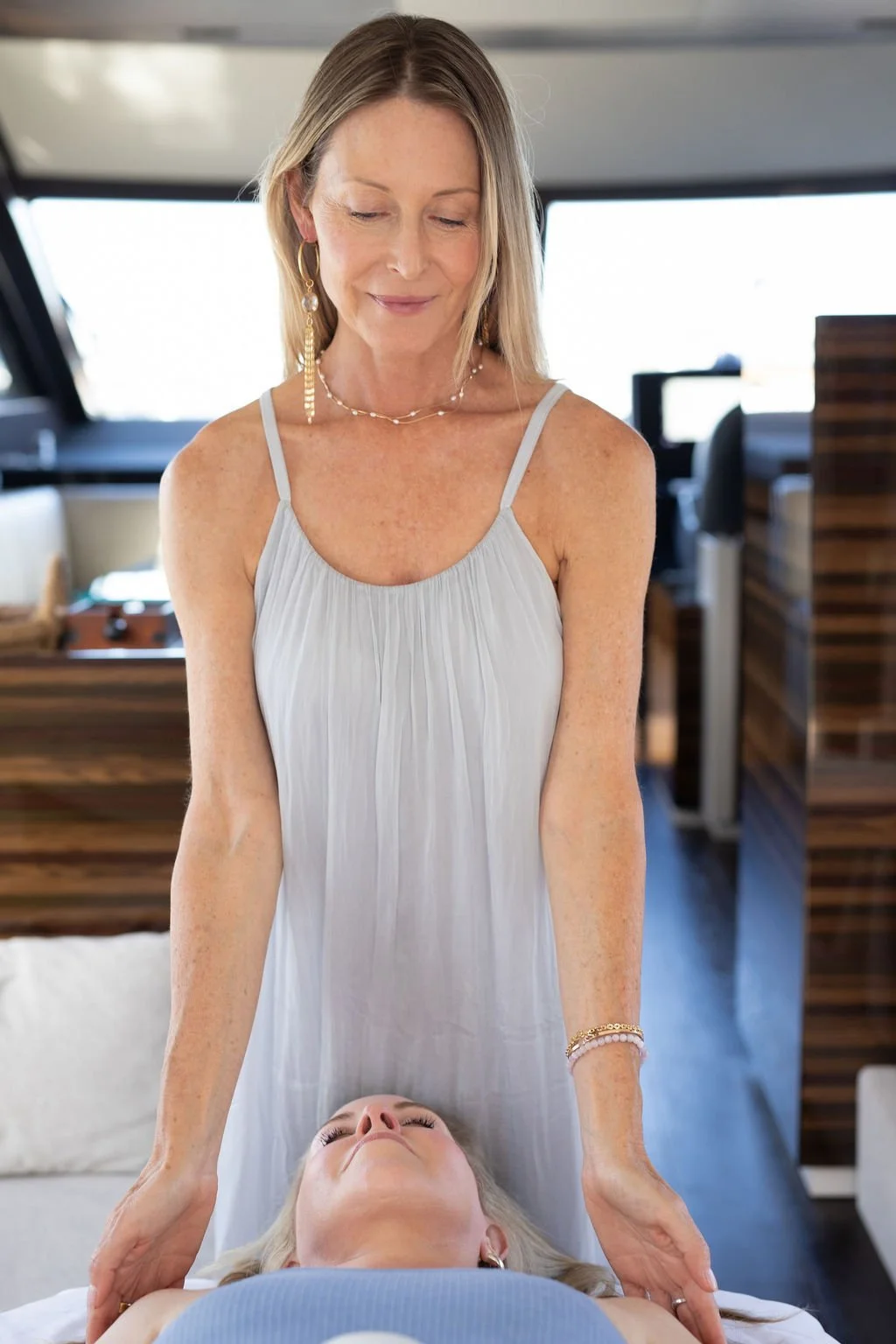
Gwen performing Reiki for a private client on a yacht
For more than 16 years, Reiki has been part of my personal and professional journey.
As a pharmacist, wellness educator, meditation teacher, and sound healer, I've spent much of my life exploring the connection between science, wellbeing, and our capacity to heal and grow.
Of all the modalities I've studied, Reiki remains one of the simplest and, in many ways, one of the most misunderstood.
Traditionally, Reiki is described as a Japanese healing practice that works with universal life force energy. For some people, that language feels intuitive. For others, it can feel unfamiliar or difficult to relate to.
After years of practice, sharing with myself daily and hundreds of clients, I've come to appreciate both perspectives.
Traditional Wisdom Through a Modern Lens
One of the reasons Reiki continues to resonate with me is that many of its traditional teachings can also be understood through a modern lens.
When Reiki practitioners speak about energy, I often think about something we experience every day. We can sense when someone is stressed. We can feel when someone is calm and grounded. We notice when a room feels tense and when a space feels welcoming.
Human beings are constantly responding to one another's presence, emotions, and nervous systems.
Traditionally, Reiki describes this through the language of energy. Today, we might also talk about nervous system regulation, co-regulation, mindfulness, presence, and the mind-body connection. Different words, perhaps, but often pointing toward a similar experience.
What Reiki Actually Is
At its core, Reiki is a gentle practice designed to support relaxation and balance.
An ancient healing modality thought to originate centuries ago in Tibet and becoming widely known in Japanese hospitals over 100 years ago, this practice harnesses the collective ‘Universal life force energy’ to promote the innate healing each of us is born with.
During a session, a practitioner offers light touch or places their hands just above the body while the recipient rests comfortably. There is nothing to achieve and nothing to perform. The invitation is simply to slow down, receive, and allow the body and mind an opportunity to rest.
Most people leave a session feeling calmer, more centered, and more connected to themselves.
One aspect of Reiki that fascinated me early on is that it can be shared both in person and at a distance.
Traditionally known as distance Reiki, this approach allows practitioners to work with clients who may be across town or across the world. Over the years, I've worked with people sitting across from me as well as clients hundreds or thousands of miles away. While every experience is unique, many people describe feeling a similar sense of relaxation, connection, and wellbeing whether the session is received near or far.
Why Reiki Feels So Relevant Today
One of the greatest challenges I see in my work is not a lack of information. Most people already know they should sleep more, stress less, and take better care of themselves.
What many people are missing is the opportunity to slow down long enough for the body to restore and recover.
We live in a culture that rewards productivity, constant connection, and doing more. As a result, many people spend years operating in a heightened state of stress without realizing how much it is affecting their wellbeing.
Whether I'm working with executives, wellness professionals, caregivers, or private clients, I often see the same thing: people are exhausted.
Traditionally, Reiki is said to help restore energetic balance. In modern language, I often describe it as creating conditions that support relaxation, recovery, and nervous system regulation.
When we feel safe, our breathing deepens, our muscles relax, and the mind becomes less busy. We get to listen to our bodies. We get to shift into peace. We get intuitive answers.
From that place, many people report sleeping better, feeling more emotionally balanced, and experiencing greater clarity, energy, and resilience. Many times. immediately.
My Reiki Story
When I first heard of Reiki, I believed it would help me recover from an abusive relationship. So I dove in right away, hoping it would help me with the pain and stress that it had caused me.
At the same time, I was also skeptical.
My background in science taught me to ask questions and look for evidence in experience. I wanted to understand why people seemed so affected by something that appeared, on the surface, so simple.
What I consistently witnessed in myself and others.
People felt calmer, more grounded, and more connected to who they were beneath the stress, pressure, and noise of everyday life.
Over time, I realized that healing doesn't always require adding more.
It begins when we create enough space for the body and mind to finally exhale.
I learned this through my own personal experience, and witnessing how it immediately affected me and my life, and in the past 16 years how it has changed the course of others’ lives and health as well.
Why I Continue to Teach and Give Reiki
I teach and share meditation, sound healing, and other practices that support wellbeing and personal growth. Yet Reiki remains one of my favorite modalities to teach because it is both accessible and deeply personal.
Anyone can learn it.
You don't need a healthcare background or years of wellness training. You simply need a desire to deepen your relationship with yourself and support the wellbeing of others.
What I appreciate most is that Reiki offers individualized support. While meditation and sound baths are wonderful for groups, Reiki creates an opportunity to focus on one person and their unique experience in that moment.
Whether shared through light touch in person or offered remotely, Reiki creates space for presence, connection, and restoration.
It offers profound shifts to the nervous system.
Some students learn Reiki as part of their own healing journey, which is why I initially learned Reiki. Others use it to support loved ones. Some eventually incorporate it into a professional wellness practice.
Regardless of where the path leads, Reiki offers something that feels increasingly valuable today: the ability to slow down, listen deeply, and support wellbeing in a meaningful way.
Perhaps that is why Reiki has remained relevant for so many years.
Not because it asks us to believe anything in particular, but because it invites us into an experience. And I believe experience is the most powerful teacher of all.
If you're feeling called to learn Reiki yourself or you're seeking restorative wellness experiences for your team, retreat, or organization, I'd love to support you.